
A batch sits in the warehouse for a few weeks and rust spots appear. The material is not at fault — sintered parts are porous by nature. Understanding both sides of that porosity is what tells you which protection to choose.
Customers often report rust spots appearing on sintered parts after a few weeks in the warehouse, occasionally spreading into patches. Material and hardness both check out. The cause is rarely the material itself — it is the structure sintered parts inherently have: they are porous.
Take an iron-based part at 6.6 g/cm³. Solid iron sits at about 7.8 g/cm³, and the difference of roughly 15% by volume is porosity. Some pores are closed; others break through the surface and connect to the outside. Moisture, hand perspiration and cleaning fluids wick into those open pores and set up galvanic corrosion on the pore walls. In the same environment, a sintered part will rust sooner than a forging or a machined part.
Yet that same porosity is the most valuable property powder metallurgy has. Oil-impregnated bearings work because the pores store oil: the part is impregnated under vacuum, oil is drawn into the interconnected pores, and in service it bleeds out with heat to form a film and provide long-term, maintenance-free lubrication. Porosity is not a defect but a characteristic to be managed — an advantage in a bearing, something to be dealt with on an exposed structural part.
The baseline protection is oil impregnation. After sintering, parts go into a vacuum impregnation unit; air is drawn out of the pores and rust-preventive oil is pressed in to fill them. That single step both protects against corrosion and provides the initial lubrication many moving parts need. The impregnation rate can be set by application, and for corrosion protection alone something above 80% is usually sufficient.
Where more is required, steam treatment is used. Parts are held in steam at 500 to 600°C, which grows a dense magnetite (Fe₃O₄) film on the pore walls and the surface, sealing the open porosity. The film is blue-black and harder than the iron matrix, so steam treatment improves wear resistance at the same time — common on gears and sprockets. The trade-off is a slight dimensional growth of a few microns, which has to be compensated for at the die design stage.
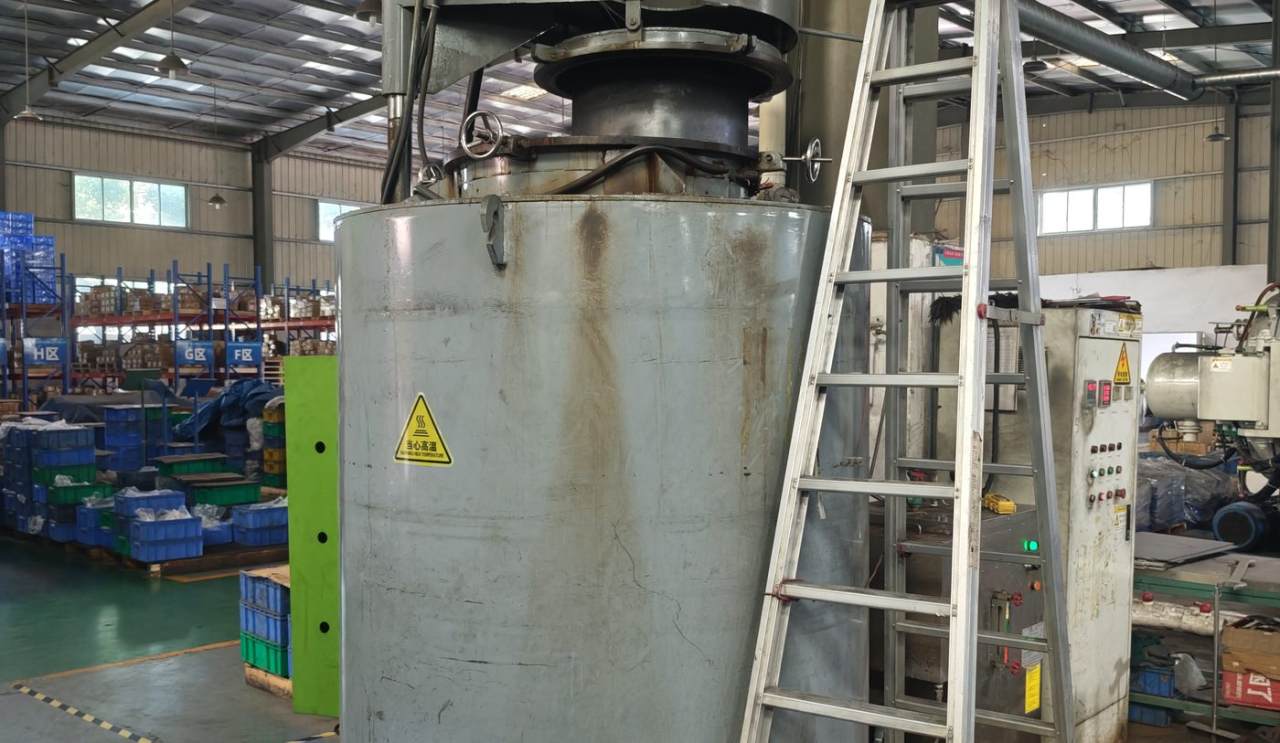
Blackening also produces a magnetite film, but mainly on the outer surface: the film is thin, dimensional change is minimal (sub-micron), and corrosion protection on its own is limited, so it is normally combined with oil impregnation. Its advantage is a uniform deep black appearance — many customers specify blackening for exactly that, plus in-process rust protection. Our shop runs a blackening furnace, and blackening followed by oil impregnation is a standard combination before shipment.
The choice follows the service environment: for in-process protection and a consistent appearance, blackening plus oil is the most economical; where corrosion resistance, wear resistance and stable dimensions are all needed, steam treatment; for oil-impregnated bearings, impregnation is part of the function itself; and for salt spray or outdoor exposure, zinc-nickel plating or zinc-flake coatings from an outside processor come into play.
One warning: every post-treatment changes dimensions and appearance, and those changes have to be written into the drawing and the technical agreement — treatment type, film thickness, salt-spray hours and appearance acceptance criteria. Leaving it until shipment puts both sides in a difficult position.
If a part has corrosion or oil-retention requirements, tell us the service environment and how it is assembled, and we can settle the post-treatment at the quotation stage.