
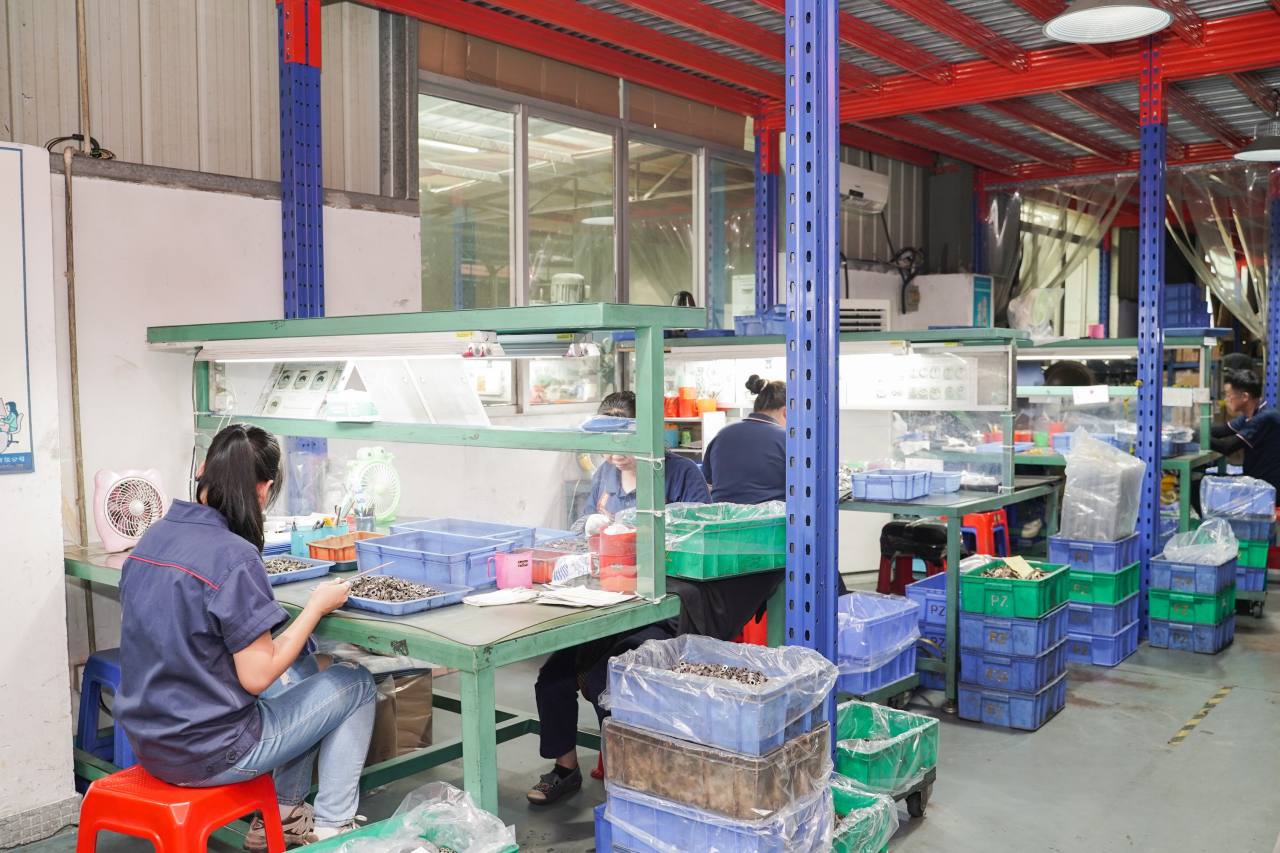
Turning a drawing into a repeatable production part means clearing feasibility review, tooling design, trial compaction, sintering parameter setting and first-article approval. Here is what is confirmed at each stage.
Turning a drawing into a part that ships reliably passes through a few distinct stages. Knowing what each stage confirms cuts the back-and-forth considerably.
The first is feasibility review. We look at whether the part can be produced by compaction and sintering at all: whether geometry blocks the pressing direction (side grooves, undercuts), whether wall thickness is grossly uneven, whether tolerances fall inside process capability, and whether volume justifies the tooling. The output is a written judgement, not a verbal price.
The second is tooling design. This sets the parting direction, pressing axis, ejection draft and the shrinkage compensation factor for each region. The drawing is checked again here to distinguish dimensions the die will hold from those needing secondary operations. Changing a drawing at this point costs almost nothing — it is the last cheap moment.
The third is trial compaction and first article. Once the die exists, a small batch is pressed to check formability, appearance and dimensions. Samples go to the inspection room and are measured on a CMM and vision system, with a report issued for the critical dimensions. The goal of this stage is not to make parts but to make correct ones.
The fourth is settling the sintering parameters. The same powder, sintered at different temperatures, times and atmospheres, gives different density, hardness and shrinkage. Trial sintering establishes the parameter window and, importantly, its stability — what matters is not one good part but consistency across many batches.
The fifth is first-article approval and volume production. Samples and the inspection report are submitted for sign-off, after which production runs steadily. Quality control then shifts from full inspection to process capability plus sampling.
End to end, the route usually takes longer than people expect, especially tooling and parameter setting. So if there is a hard project deadline, say so at the enquiry stage — we can then judge whether it is achievable or whether some stages can run in parallel.
One last note: the completeness of the drawing drives the speed of everything. Material, heat treatment, the datum for inspecting critical dimensions, surface finish — the more complete, the faster the review and quotation. A 3D model without tolerance callouts normally means another round of questions.