
A compacted part is still just powder pressed into shape. What turns it into metal is sintering — and every stage of the temperature curve changes density, microstructure and dimensions.
The part that comes out of the press is called a green compact. It already has its final shape, but its strength is only enough to be handled and loaded into the furnace: the powder particles are held together by mechanical interlocking and lubricant, and it breaks easily. What turns that powder into a single piece of metal happens next, inside the sintering furnace.
Sintering is not simply heating the part up. It is a controlled temperature profile, usually in three stages: ramp, hold and cooling. Ten degrees or half an hour either way, and the resulting density, hardness and dimensions all shift.
The ramp stage clears the way. Compaction leaves roughly 0.5% to 1% lubricant in the part to reduce ejection friction, and that organic material has to burn out slowly before the furnace reaches sintering temperature. If it decomposes too fast it releases a large volume of gas, cracking the part or leaving carbon residue behind. Ramp rates are therefore held back, with a soak around 400 to 650°C for the volatiles to escape. Parts that are not properly delubricated typically show blistering or dark patches after the furnace.
The hold stage is where metallurgical bonding actually happens. At sintering temperature — for iron-based materials usually between 1100 and 1300°C — atoms diffuse between particles, necks grow at the contact points, pores spheroidise and shrink, and the part densifies and contracts as a whole. Density, strength and hardness are largely fixed here. Longer is not better: an excessive hold coarsens the grains and costs both toughness and dimensional accuracy.
Cooling is often overlooked, yet it sets microstructure and residual stress. Cool too fast and the temperature gradient between surface and core tears thin walls and shoulders; cool too slowly and grains grow, lowering strength. Some parts use this stage deliberately for sinter hardening: the cooling rate is controlled so the surface forms martensite and the required hardness is reached straight out of the furnace, skipping a separate quench.
Furnace atmosphere matters as much as temperature. Iron-based parts typically run under a nitrogen-hydrogen mixture or dissociated ammonia, which does two jobs: it displaces residual oxygen to prevent oxidation, and it reduces the oxide film on the powder particles — without that reduction the particles cannot bond. Poor dew-point control leads to decarburisation (a soft surface) or carburisation (a brittle one), and hardness and dimensions drift with it.
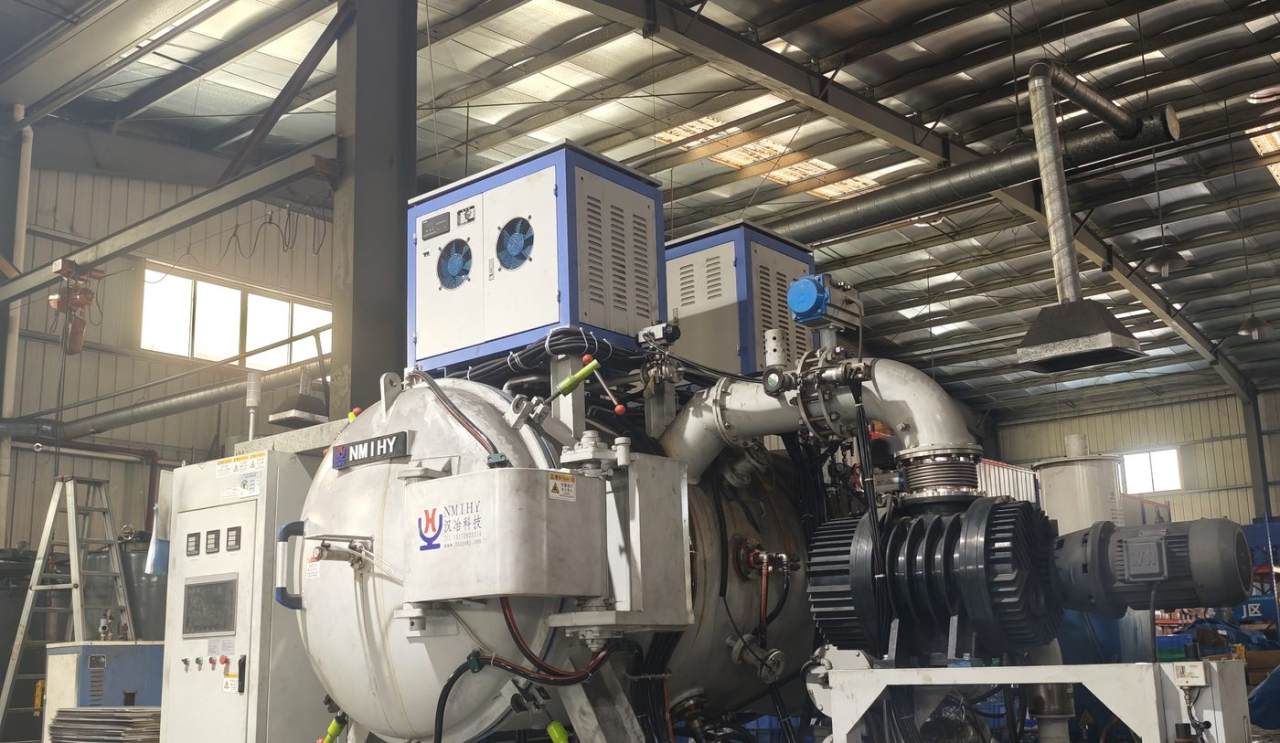
This is why our shop runs two kinds of furnace. A continuous sintering furnace handles regular iron-based parts with a stable output and a predictable cycle; a vacuum furnace is reserved for stainless and chromium-bearing materials, or parts that demand higher purity. Vacuum degasses more thoroughly and leaves cleaner pore surfaces, but it brings its own constraints — some alloying elements volatilise at high temperature in vacuum, so the mix and the profile have to be adjusted accordingly.
For a buyer, there is a simple question that tells you whether a sintering supplier is serious: are the sintering profiles recorded, and can they be traced? If temperature, atmosphere and belt speed exist only as an operator's experience, batch-to-batch variation becomes very hard to explain. We keep every profile on file, so an issue can be traced back to a specific furnace run.
If you have a part under evaluation, send us the drawing and annual volume. We can tell you whether sintering suits it, and which density and tolerance band it needs.